【Toyota Automobile Museum】 Exploring the Evolution and Culture of Cars Worldwide
- PREFECTURE
- AICHI
The museum is divided into two main areas: the "Automobile Gallery" and the "Cultural Gallery." It aims to create a space where visitors can learn about the history of automobiles and envision the future of mobility, all while contributing to car culture together. Vehicles from the late 19th century to the present day are displayed chronologically.
CONTENT
View the History of Automobiles with Around 140 Vehicles from Japan, the U.S., and Europe in the “Automobile Gallery”

The “Automobile Gallery” showcases the history of automotive technology and culture from the birth of gasoline-powered cars to the present day, featuring around 140 representative vehicles from around the world.
On the 1st floor, the Symbol Zone displays a faithful reproduction of Toyota’s first mass-produced passenger car, the “Toyota AA” (1936 replica), created based on original blueprints to commemorate the museum’s opening in April 1989. It also features reliefs of the Koromo Plant from that era.
On the 2nd floor, “From the Dawn of Automobiles to the Birth of Japanese Cars” showcases the world’s first practical gasoline car, the “Benz Patent Motorwagen” (1886 replica), along with the global development of automotive technology and culture up to the 1950s. The history is divided into eight zones: “1890-1910s,” “1910s,” “1910-1930s,” “1920-1930s,” “1920-1940s,” “1930s,” “1930-1940s,” and “1930-1950s.” In addition to the cars, photos from each era are displayed to provide insight into the cultural context of the times.
The 3rd floor, “Evolution and Diversification of Motorization,” covers the advancements and challenges of global automotive history from the 1950s to the present. The evolution is divided into five zones: “1950s,” “1960s,” “1970s,” “1980s,” and “20XXs,” offering insights into the development of environmentally friendly cars, including hydrogen and electric vehicles.
The museum offers free guided tours at scheduled times, where staff provide detailed explanations of the history and highlights of the exhibits. Display panels are available in four languages: Japanese, English, Chinese, and Korean (some are bilingual).
Explore the History of Cars and Culture in the “Automobile Culture Room”
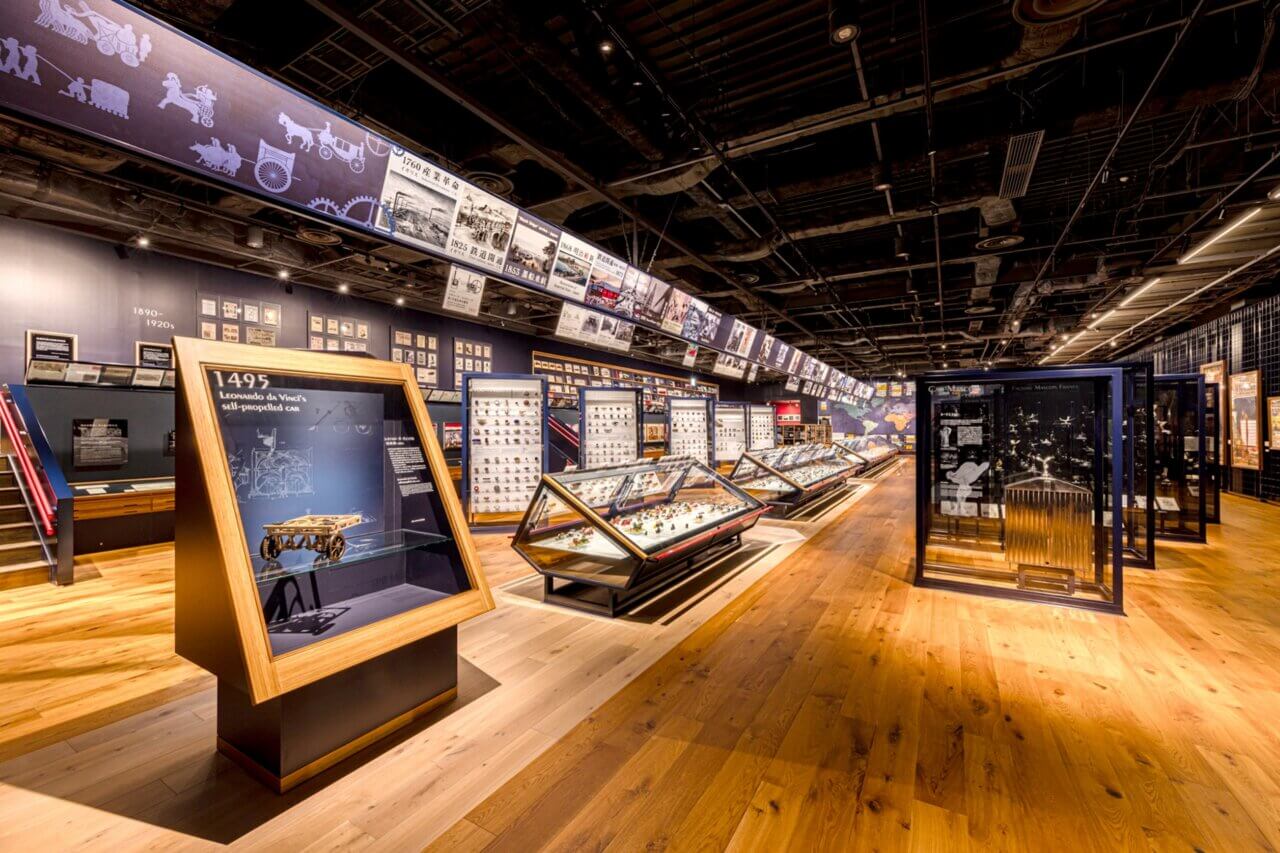
On the 2nd floor of the “Cultural Gallery,” the “Automobile Culture Room” displays around 4,000 items from over 200,000 cultural artifacts related to automobiles collected by the Toyota Automobile Museum under the theme “Mobility is Culture.” A display case showcases around 800 miniature cars made at a 1/43 scale, divided into three sections based on the two world wars, representing Japan, the U.S., and Europe.
The room also features ukiyo-e prints, hikifuda, automotive magazines and catalogs, car posters, car badges, mascots, automobile stamps, car toys and games, license plates, literature, manga, movies, and music. These items provide various perspectives on the relationship between people, culture, and cars. The ukiyo-e and car posters are rotated every few months to protect the artworks, allowing visitors to enjoy fresh displays on each visit.
The “Automobile Culture Room” also offers scheduled guided tours that highlight the room’s main attractions.
A Permanent Exhibition Showcasing the Birth and Development of Japan’s Automotive Industry: “The History of Car Manufacturing in Japan”
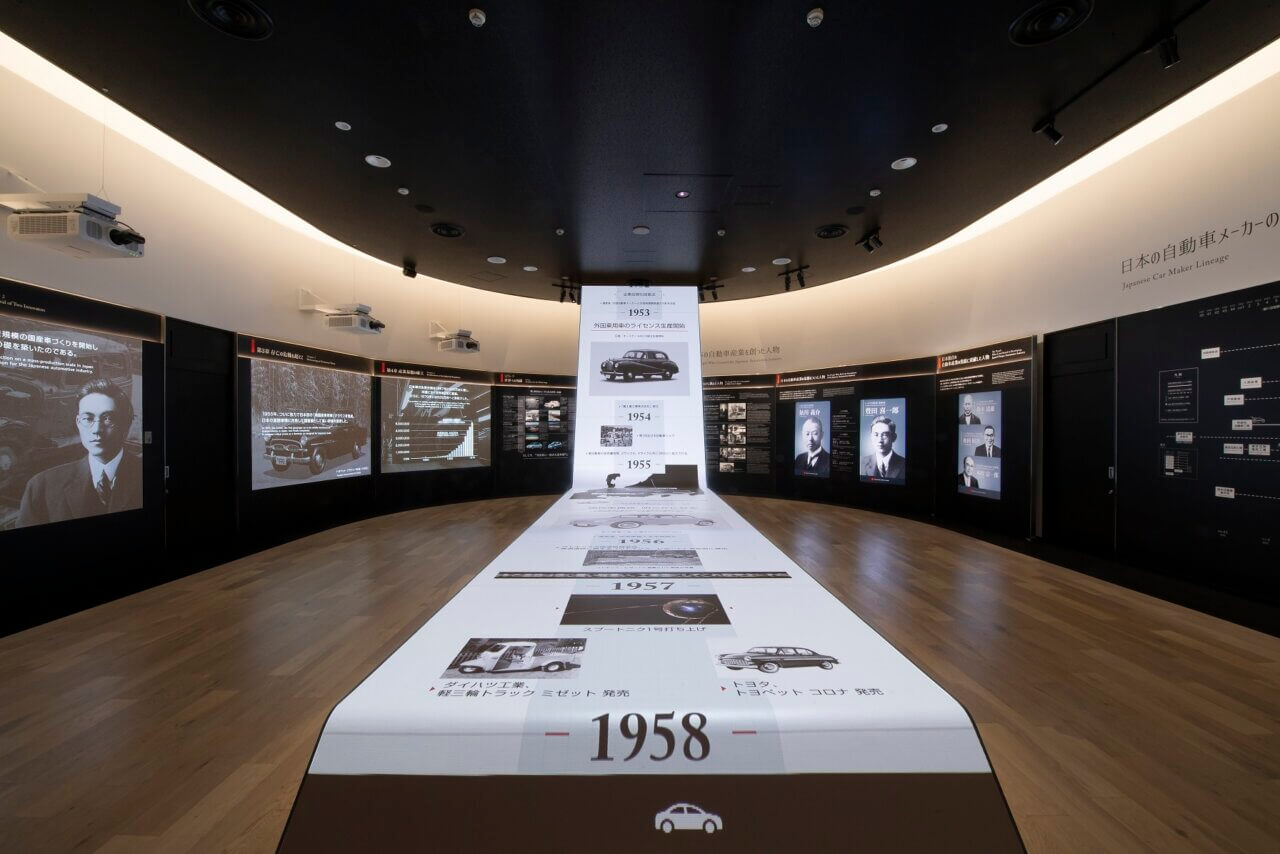
On April 16, 2022, a new permanent exhibition corner, “The History of Car Manufacturing in Japan,” opened on the 2nd floor of the “Automobile Gallery.” This exhibition covers approximately 70 years of the development of Japan’s automotive industry from five perspectives.
The “History Road” features a “moving timeline” that introduces historical events in Japanese car manufacturing from the arrival of the first automobile in Japan in 1898 to the present day, using photos and animations.
Surrounding the “History Road” are several themed areas: The “Story” area introduces the foundation of Japan’s automotive industry with panels and videos. The “People” area highlights pioneers and founders who contributed to the formation of the industry. The “Genealogy” area presents a large diagram showcasing the history of 12 major Japanese car manufacturers. The “Numbers” area displays an infographic charting Japanese automobile production numbers from 1904 to 2020, offering various perspectives on the establishment of Japan’s automotive industry.
Enjoy the Restaurant, Café, and Shop!

The Toyota Automobile Museum features a restaurant, café, and shop to enhance your visit.
The museum restaurant “AVIEW” offers reasonably priced lunch options centered on Western cuisine. The recommended dishes are the “Toyota Museum’s Signature Curry” with car-shaped rice and the “Chef’s Special Seasonal Lunch,” both popular menu items. There are also children’s menus available, making it a great choice for families. The restaurant is open for dining even if you’re not visiting the museum.
The museum café “CARS & BOOKS” allows visitors to enjoy delicious coffee or tea while browsing books, providing a relaxing environment to discuss cars after touring the exhibits. The café offers carefully selected coffee beans from a specialty coffee roastery in Minokamo City, Gifu Prefecture, and organic teas from a tea specialty store in Nagoya.
The book selection, curated by book director Yoshitaka Haba’s team “BACH,” includes a variety of photobooks, art books, novels, and manga, all centered around the joy of driving. Feel free to pick up a book that catches your eye and relax with a drink.
Don’t forget to visit the museum shop for souvenirs. The shop offers a wide range of original products, including the popular “Museum Curry” and “Spanner Spoon,” perfect for commemorating your visit.
AICHI
-
![【SHITARA VILLAGE】A Resort Stay Immersed in the Nature of Southern Nagano and Oku-Mikawa]()
【SHITARA VILLAGE】A Resort Stay Immersed in the Nature of Southern Nagano and Oku-Mikawa
-
![【Non Hoi Park】 A Comprehensive Botanical and Zoological Park Where You Can Feel Close to Living Creatures and Nature]()
【Non Hoi Park】 A Comprehensive Botanical and Zoological Park Where You Can Feel Close to Living Creatures and Nature
-
![【Toyokawa Inari】A Sacred Site of Prosperity Protected by a Fox-Riding Deity]()
【Toyokawa Inari】A Sacred Site of Prosperity Protected by a Fox-Riding Deity
-
![【Laguna Ten Bosch】 Enjoy playing, eating, and shopping at this large-scale resort overlooking Mikawa Bay!]()
【Laguna Ten Bosch】 Enjoy playing, eating, and shopping at this large-scale resort overlooking Mikawa Bay!
-
![【Takeshima Aquarium】 Japan’s No. 1 in Species Variety! A Deep Dive into Rare Deep-Sea Creatures]()
【Takeshima Aquarium】 Japan’s No. 1 in Species Variety! A Deep Dive into Rare Deep-Sea Creatures
-
![【Sakushima】A Charming Island of Healing and Art Floating in Mikawa Bay]()
【Sakushima】A Charming Island of Healing and Art Floating in Mikawa Bay



history
-
![【Non Hoi Park】 A Comprehensive Botanical and Zoological Park Where You Can Feel Close to Living Creatures and Nature]()
【Non Hoi Park】 A Comprehensive Botanical and Zoological Park Where You Can Feel Close to Living Creatures and Nature
-
![【Toyokawa Inari】A Sacred Site of Prosperity Protected by a Fox-Riding Deity]()
【Toyokawa Inari】A Sacred Site of Prosperity Protected by a Fox-Riding Deity
-
![【Asuke (Korankei)】 A Town of History, Tradition, and Nostalgia]()
【Asuke (Korankei)】 A Town of History, Tradition, and Nostalgia
-
![【Toyota Commemorative Museum of Industry and Technology】 Experience the Evolution of Toyota Group’s Technology]()
【Toyota Commemorative Museum of Industry and Technology】 Experience the Evolution of Toyota Group’s Technology
-
![【Aichi Asahi Archaeological Museum】 See, Touch, and Experience the World of the Yayoi Period]()
【Aichi Asahi Archaeological Museum】 See, Touch, and Experience the World of the Yayoi Period
-
![【Atsuta Jingu (Atsuta Shrine)】It receives about 6.5 million visitors annually! A highly respected shrine since ancient times]()
【Atsuta Jingu (Atsuta Shrine)】It receives about 6.5 million visitors annually! A highly respected shrine since ancient times


museum
-
![【Non Hoi Park】 A Comprehensive Botanical and Zoological Park Where You Can Feel Close to Living Creatures and Nature]()
【Non Hoi Park】 A Comprehensive Botanical and Zoological Park Where You Can Feel Close to Living Creatures and Nature
-
![【Toyota Commemorative Museum of Industry and Technology】 Experience the Evolution of Toyota Group’s Technology]()
【Toyota Commemorative Museum of Industry and Technology】 Experience the Evolution of Toyota Group’s Technology
-
![Hikari Museum: A Unique Space Blending Art and History]()
Hikari Museum: A Unique Space Blending Art and History
-
![【Toyota Municipal Museum of Art】A Museum That Feels Like a Work of Art Itself]()
【Toyota Municipal Museum of Art】A Museum That Feels Like a Work of Art Itself
-
![【INAX Live Museum】An experiential museum where you can explore the diverse world of clay and ceramics]()
【INAX Live Museum】An experiential museum where you can explore the diverse world of clay and ceramics
-
![【Aichi Museum of Flight】Inspiring the Dream of Flight for Future Generations]()
【Aichi Museum of Flight】Inspiring the Dream of Flight for Future Generations


-450x450.jpg)